Lead Paint Inspection Insights
The Data Behind Every Lead-Safe Renovation
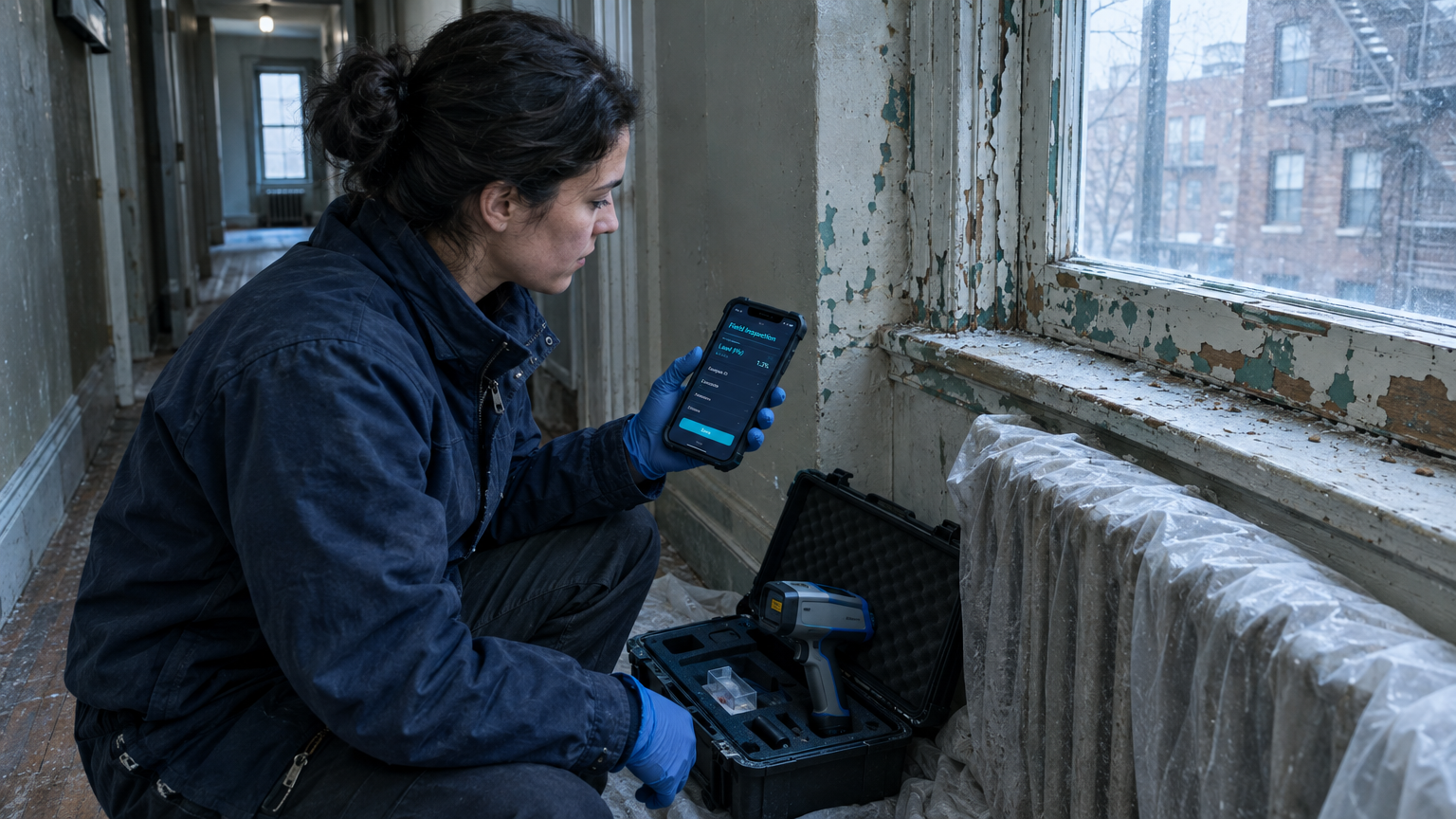
Lead-based paint inspection depends not only on testing surfaces, but on collecting, connecting and proving the information generated in the field — especially across multi-unit and multi-building portfolios, where one renovation can touch hundreds of painted components in dozens of units.
01 · Industry context
The Scale of the Problem
Lead-based paint is not a historical curiosity. It is present in a large share of the housing that gets renovated, repaired and re-tenanted every year — and every one of those buildings carries painted components that may have to be tested, documented and cleared.
31 million
pre-1978 U.S. homes still contain lead-based paint, per EPA's October 2024 announcement of tightened dust-lead standards.
Source: EPA newsroom release, Oct 24, 20243.8 million
of those homes have a child under six living there — the age group most vulnerable to lead exposure.
Source: EPA newsroom release, Oct 24, 202438 million
housing units — about 40% of all U.S. housing — contain some lead-based paint, per HUD's National Survey of Lead and Allergens in Housing. Lead-based paint was banned for residential use in the U.S. in 1978.
Source: EPA lead FAQ, citing HUD National Survey02 · Fundamentals
What Is a Lead-Based Paint Inspection?
The two activities are often confused because both involve a trained professional testing paint — but they answer different questions, and HUD's Guidelines for the Evaluation and Control of Lead-Based Paint Hazards in Housing defines the distinction.
Inspection
Answers: is lead-based paint present, and where?
—Surface-by-surface testing to determine the presence of lead-based paint — every painted component, not a guess from the building's age.
—Typically performed with an XRF analyzer spot-testing surfaces in place, with lab-confirmed paint-chip samples where the reading is inconclusive.
—Produces a component-level inventory: which walls, trim, doors, windows and radiators are coated with lead-based paint.
Risk assessment
Answers: does that paint create a hazard, right now?
—Identifies lead-based paint hazards specifically — deteriorated or peeling paint, lead dust on floors and sills, and lead in bare soil.
—Goes beyond presence: a sound lead-paint coating intact on a wall may not be an immediate hazard; the same coating churning into dust at a window may be.
—Includes dust and soil sampling, typically lab-analyzed, and a hazard determination for each location tested.
A related but separate step: clearance testing is dust-wipe sampling performed after abatement or renovation work, to confirm the work area is safe for reoccupancy. It is the finish line of the process — and, as section 05 covers, the pass/fail line it is judged against changed in 2024.
03 · Exposure science
Why There Is No Safe Level
Two national public-health agencies — the CDC in the United States and Health Canada — converge on the same core conclusion while framing their guidance differently. Both frameworks are presented side by side; they are not directly comparable instruments.
The CDC's blood lead reference value is 3.5 µg/dL, set using NHANES data on children ages 1–5 (the 2015–2016 and 2017–2018 cycles) at the 97.5th percentile — the level at which a child's blood lead is higher than 97.5% of children in that reference population.
The CDC states plainly that there is no known safe blood lead level (BLL) — the reference value is a screening trigger for action, not a threshold below which exposure is harmless.
Scale of surveillance: CDC receives about 3 million blood lead tests per year, and has run national childhood blood-lead surveillance since 1995.
Health Canada frames risk by a home's build year: homes built before 1960 probably contain lead-based paint; homes from 1960–1990may have lead-based paint on exterior surfaces and smaller, still-harmful amounts on interior surfaces; homes built after 1990 should be lead-free, since consumer paints in Canada and the U.S. were virtually lead-free by then.
Like the CDC, Health Canada states there is no known safe level of lead exposure.
Note the difference in instruments: a blood-lead reference value from a health survey is not the same kind of measure as build-year risk guidance for housing stock — each answers a different question, and neither should be read as the other.
04 · Impact
The Human and Economic Toll
HUD counts the families living with lead-based-paint hazards; researchers have tried to count what each year's affected cohort costs. The two cost figures below come from different research groups using different thresholds — they are presented as published, not averaged or reconciled.
3.3 million
U.S. families with a child under six live in a home with one or more lead-based-paint-hazard conditions.
Source: HUD Lead Fact Sheet, Oct. 27, 20212.1 million
of those families have low incomes — the households least able to fund abatement themselves.
Source: HUD Lead Fact Sheet, Oct. 27, 2021Two independent cost estimates — deliberately not reconciled
Up to $10.9 billion per annual cohort
Columbia Law School Health Justice Advocacy Clinic
—Estimates that one annual cohort of children aged one to two with blood lead levels above 5 µg/dL costs as much as $10.9 billion.
—The cost recurs yearly as each new cohort of children is affected — a recurring bill, not a one-time total.
Up to $83.7 billion
Altarum, 2019 study
—Estimates costs as high as $83.7 billion for children with blood lead levels above 2 µg/dL.
—Includes $36.7 billion in local, state and federal government spending.
05 · Regulation
The Rules Keep Tightening, The Buildings Don't
In October 2024, EPA issued a final rule tightening the dust-lead levels that count as passing a post-abatement clearance test. The paint on the walls of a 1920s building did not change — the pass line did.
10 µg/ft²
5 µg/ft²
100 µg/ft²
40 µg/ft²
400 µg/ft²
100 µg/ft²
The reportable dust-lead level is now "any reportable level measured by an EPA-recognized laboratory" rather than a fixed numeric floor. EPA projects the rule will reduce lead exposure for up to nearly 1.2 million people per year, including 178,000 to 326,000 children under six.
Dust-lead post-abatement clearance levels: 2023 vs. 2024 standard
µg/ft² (micrograms of lead per square foot) — figures as stated in EPA's October 2024 final rule announcement- Previous clearance level
- 2024 tightened level
Tightening the standard doesn't change what is already on the walls of a 1920s building — it changes what counts as a pass on a clearance test performed today. That has a direct consequence for documentation: a dust-wipe result from five years ago that "passed" under the old 10 µg/ft² floor standard would fail against today's 5 µg/ft² level. Historical test records need to be read in the context of the standard that was in force when they were taken — which means the standard in effect at test time is itself a piece of data worth keeping with the record.
06 · Scope of inspection
What Needs to Be Inspected
A lead-based paint inspection is component-by-component work. The diagram below shows the typical categories of tested components in a residential building — illustrative, not exhaustive.
Why windows get particular attention
Windows and window components — sashes, jambs, stops, troughs — are a common focus because opening and closing a painted window rubs lead-based coatings against themselves. That friction-generated dust settles on sills and troughs, exactly where children's hands and dust-wipe samples both go. A wall can hold intact lead paint for decades; a window can renew the hazard every time it moves.
Who sets the protocol
The specific testing protocol — how many readings or samples, which components, XRF spot-testing versus lab-confirmed paint-chip analysis — is set by HUD's Guidelines for the Evaluation and Control of Lead-Based Paint Hazards in Housing and by state and local requirements, which can be stricter than the federal baseline. The list above is illustrative rather than exhaustive.
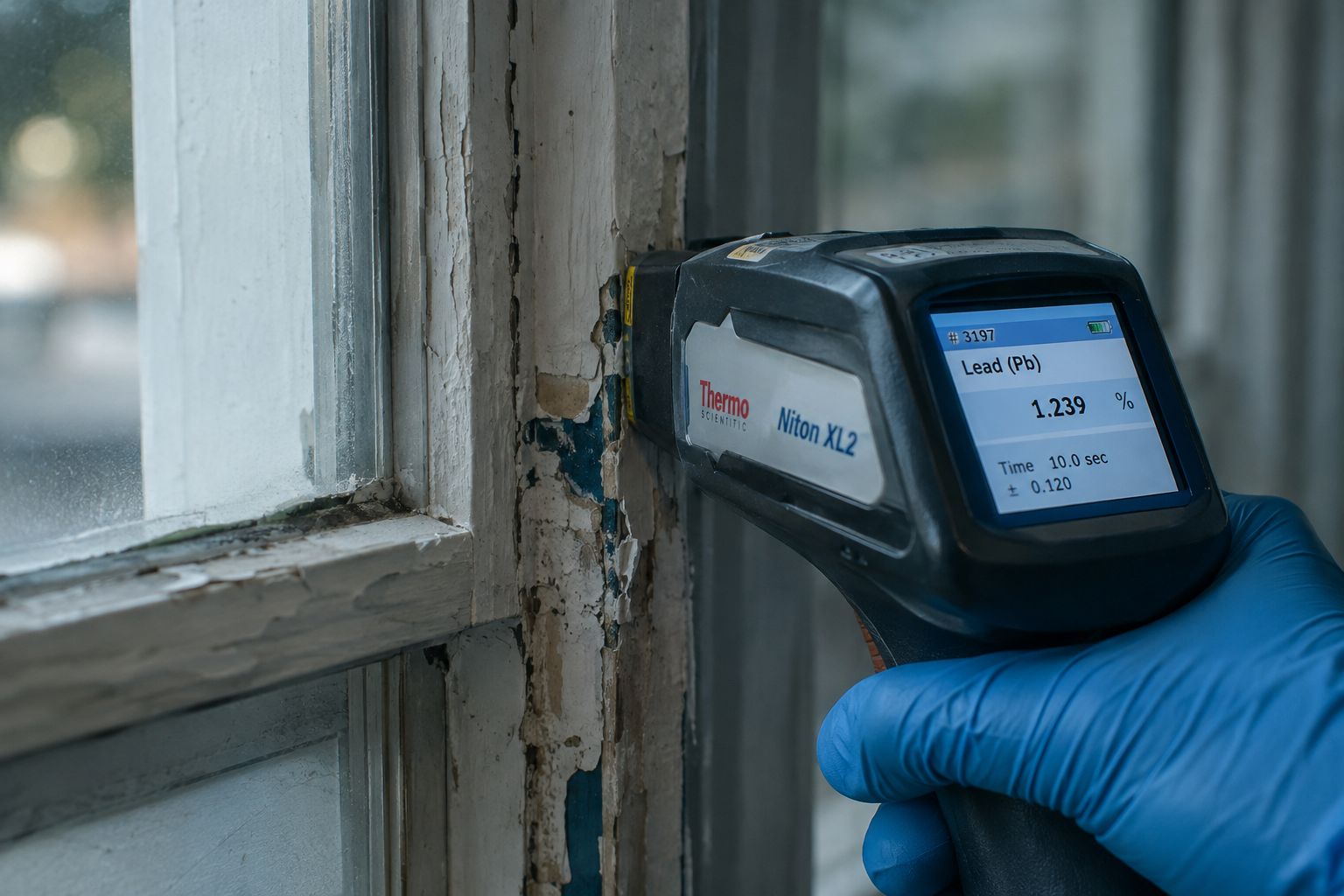 XRF spot-testing at a window frame: a component-level reading taken in place, tied to a specific window in a specific unit.
07 · Two data types
Field Testing Data vs. Lab-Confirmed Data
Lead inspection runs on two complementary kinds of evidence, and one does not replace the other — an XRF reading tells you where to look; a lab-confirmed sample is often what a clearance determination or a legal record relies on.
—Instrument readings captured on site, by component and location — wall, trim, door, window sash.
—Same-day availability: the reading exists the moment the analyzer is lifted from the surface.
—Non-destructive: no paint chip removed, no patch to repair, so every painted component can be screened.
—Best used to build the component-level inventory and flag where confirmatory sampling is needed.
—Paint-chip and dust-wipe samples sent to an accredited laboratory for confirmatory analysis.
—Carries chain-of-custody from sample to lab to report — who handled it, when, and where it traveled.
—Destructive or semi-destructive for paint chips, and dust wipes only sample what they wipe.
—Often the evidence a clearance determination or a legal record relies on — the number with a lab's name behind it.
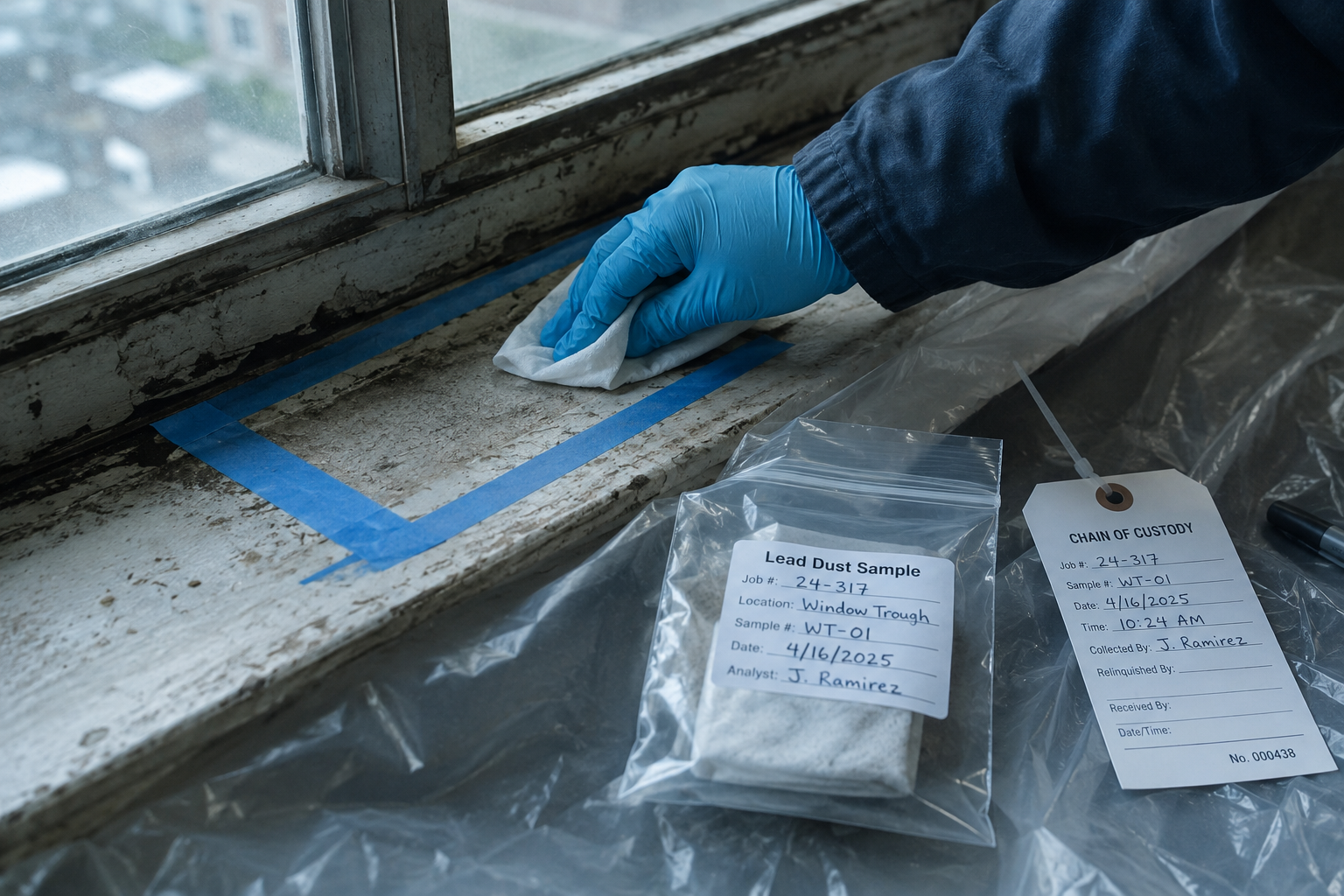 Dust-wipe sampling for clearance: lab-confirmed evidence, with chain-of-custody from the floor to the report.
08 · Asset history
Why Historical Data Matters, Especially Across Multi-Unit Properties
A single inspection is a snapshot. A multi-unit or multi-building portfolio needs to track hundreds of components across dozens of units over years — and the value of those records compounds when they can be compared, not just filed.
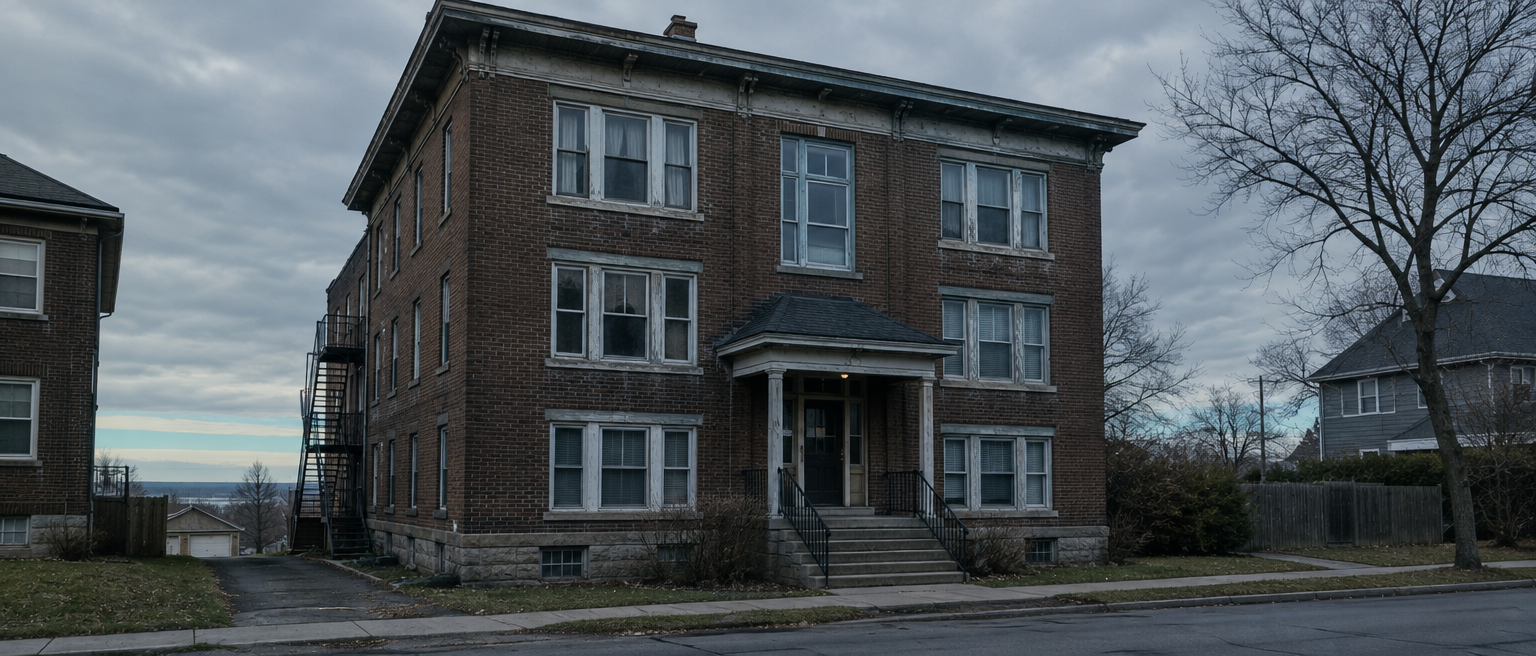 One building, many units, years of tests: pre-renovation surveys, post-abatement clearance tests and periodic reassessments describe the same components at different moments.
Records accumulate by type and by time
The same portfolio accumulates pre-renovation surveys, post-abatement clearance tests, and periodic reassessments required for rental housing — three kinds of record about the same physical components, taken under different standards at different dates.
Comparison is where the value lives
A clearance test that passed in 2019 was judged against a different standard than one taken in 2025 (see section 05). Comparing results unit-to-unit and year-to-year — rather than reading each once and filing it — is what turns stored documents into working knowledge.
09 · Renovation triggers
The EPA RRP Rule — Who Has to Test Before Disturbing Paint
It is not only inspectors who need lead-paint information. Under EPA's Renovation, Repair and Painting (RRP) Rule (40 CFR Part 745), the contractor doing the work needs it too.
6 sq ft
of interior painted surface disturbed is the RRP Rule's threshold in pre-1978 housing or child-occupied facilities.
20 sq ft
of exterior painted surface disturbed is the corresponding exterior threshold under the same rule.
Contractors disturbing more than those thresholds in pre-1978 housing or child-occupied facilities must be lead-safe certified and follow specific work practices under the rule. That makes the underlying inspection and clearance records operational inputs to renovation work — and it frames why documentation has to be defensible, not just accurate: a record that cannot show which unit, which component, which method and which standard applies is harder to stand on when a regulator, owner or tenant asks what was found and what was done about it.
10 · Strategy landscape
Four Responses to Lead-Based Paint — Used in Combination
These approaches are not interchangeable, and real programs use several of them depending on the property and the trigger — a sale, a renovation, a tenant complaint, or a routine reassessment.
Inspection
Determine the presence of lead-based paint, component by component — typically by XRF spot-testing, with lab-confirmed paint-chip samples where needed.
Risk assessment
Identify actual hazards — deteriorated paint, lead dust, lead in soil — not just presence. Answers whether the paint is harming anyone right now.
Abatement / interim controls
Abatement permanently removes the hazard; interim controls temporarily manage it (repainting intact, specialized cleaning, encapsulation). Different obligations, different records.
Clearance testing
Confirm the area is safe to reoccupy after work — dust-wipe sampling against the applicable clearance levels, lab-confirmed.
11 · The information problem
The Problem With Disconnected Lead Data
No serious claim can be made that the whole industry works on paper — many firms run well-integrated systems. But in some lead inspection workflows, information ends up scattered across five places that describe the same building.
XRF readings locked in one analyzer or copied into a paper log
Lab results arriving separately from the components and units they describe
Photos on a technician's phone, disconnected from the component they show
Unit-by-unit files that don't roll up across a building, let alone a portfolio
Compliance deadlines and retest dates tracked in yet another system
In a multi-unit portfolio this isn't a minor inconvenience — it's the difference between answering a regulator's request in minutes and reconstructing it from four places under deadline pressure. The same scenario is walked through step by step in aQRate's multi-unit case study (linked in section 08 and in Sources below).
12 · Connected workflow
A Connected Field-Data Workflow
A connected workflow closes the gaps above: information is captured once, in the field, and flows — with the component and unit — through validation, review, reporting and analysis, then back into the next round of testing.
Two steps in this workflow — validate and synchronize — are where disconnected processes usually fail. A record that reaches the office missing its component association, or that never leaves the technician's device, cannot feed the unit history that later compliance answers depend on.
13 · Practical framework
What Good Lead Inspection Data Looks Like
A useful inspection record answers a short set of questions. This is a practical educational framework, not a formal standard — but a record that cannot answer them is usually not answering much later either.
01
What?
The component tested — window sash, door jamb, radiator, sill.
02
Where?
Property, building and unit, down to the location on the component.
03
When?
The test date — which also fixes the standard that was in force.
04
Who?
The technician who took the reading, and the reviewer who accepted it.
05
What was found?
The XRF reading or lab result, and the hazard determination made from it.
06
Evidence?
Photo, lab report, chain-of-custody record attached to the finding.
07
What happened next?
Abatement scheduled, retest ordered, or area cleared for reoccupancy.
08
Historical context?
How this result compares to the last test of the same component.
14 · Where software helps
How aQRate Supports This Workflow
Most of this article has been about the domain. This part is about aQRate — kept short, and kept separate from the facts above.
In the field
Field crews capture structured inspection records — component, location, XRF reading, photo — on a phone or tablet, per unit, instead of typing them up afterwards.
Across a portfolio
For multi-unit and multi-building properties, records are organized and searchable by property, building and unit — so portfolio-wide compliance status is visible at a glance rather than assembled from unit-by-unit files.
(a) LIDAR floor-plan sketches. LIDAR-capable iOS devices can now sketch a property or unit's layout directly in the field app — so tested components are pinned to a floor plan instead of described in text.
(b) One-click Word report templates. Upload your own compliance report template once, map the data fields, and generate a filled report with one click — instead of retyping results into a template every time.
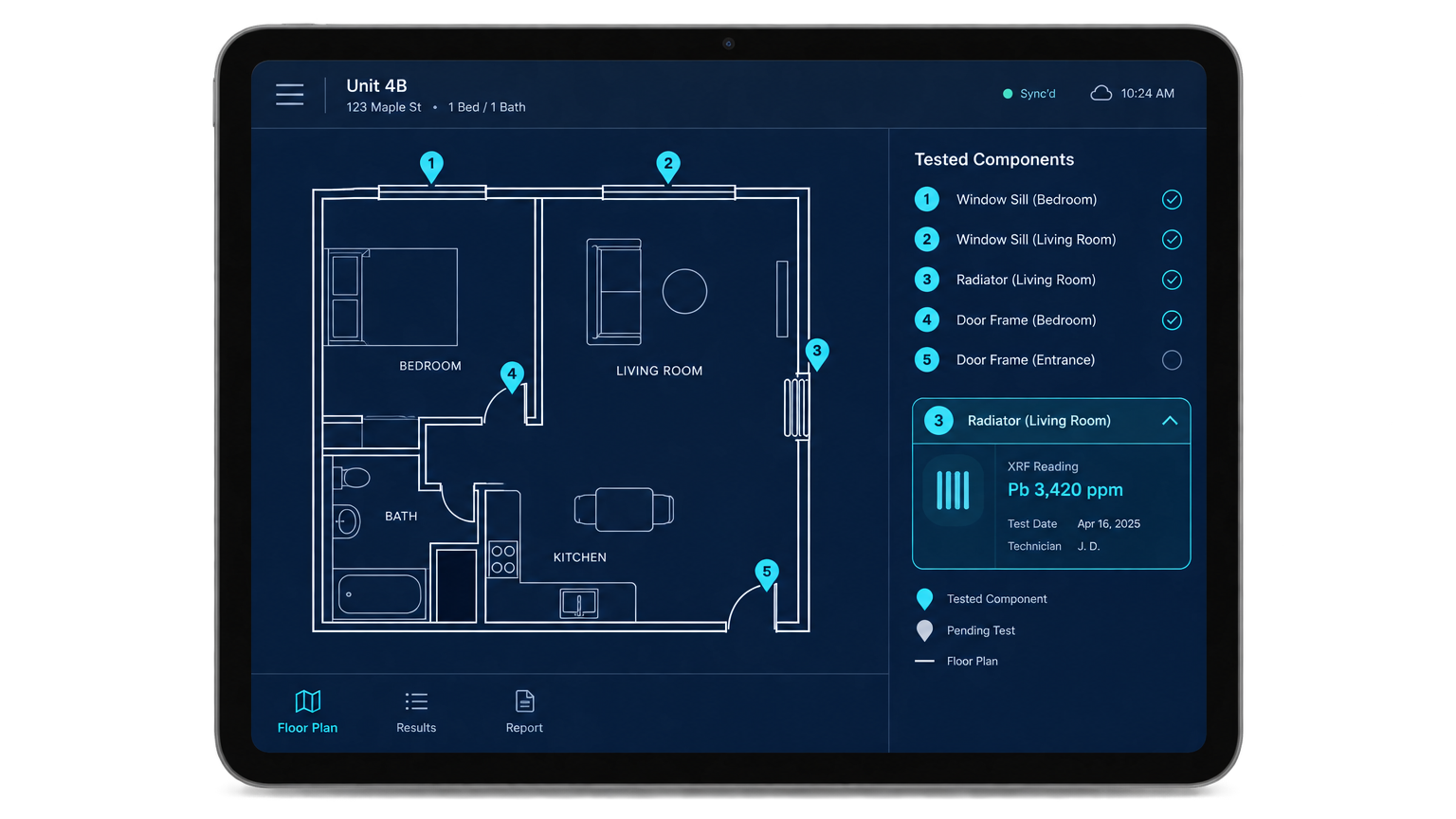 Components pinned to a LIDAR floor-plan sketch: the record shows which window, where, not just a text description.
aQRate is a field-data collection and inspection-management platform. It does not replace a certified inspector's or risk assessor's professional determination; it does not replace accredited laboratory analysis of paint-chip or dust-wipe samples; and it does not make legal clearance or compliance determinations on its own. The professionals' and the lab's judgments stay theirs — aQRate's job is making the record of those judgments complete, connected and retrievable.
15 · A concrete example
Try a Lead Paint Inspection Form
The form below is a working example of a lead-based-paint component inspection form — component, unit/location, test method, XRF reading or lab result, hazard determination, photo. Fill it in and submit to see the record it produces.
Lead-Based Paint — Component Inspection
Demo form — sample data only; thresholds shown are the HUD Guidelines' XRF (1.0 mg/cm²) and lab (0.5% by weight) criteria.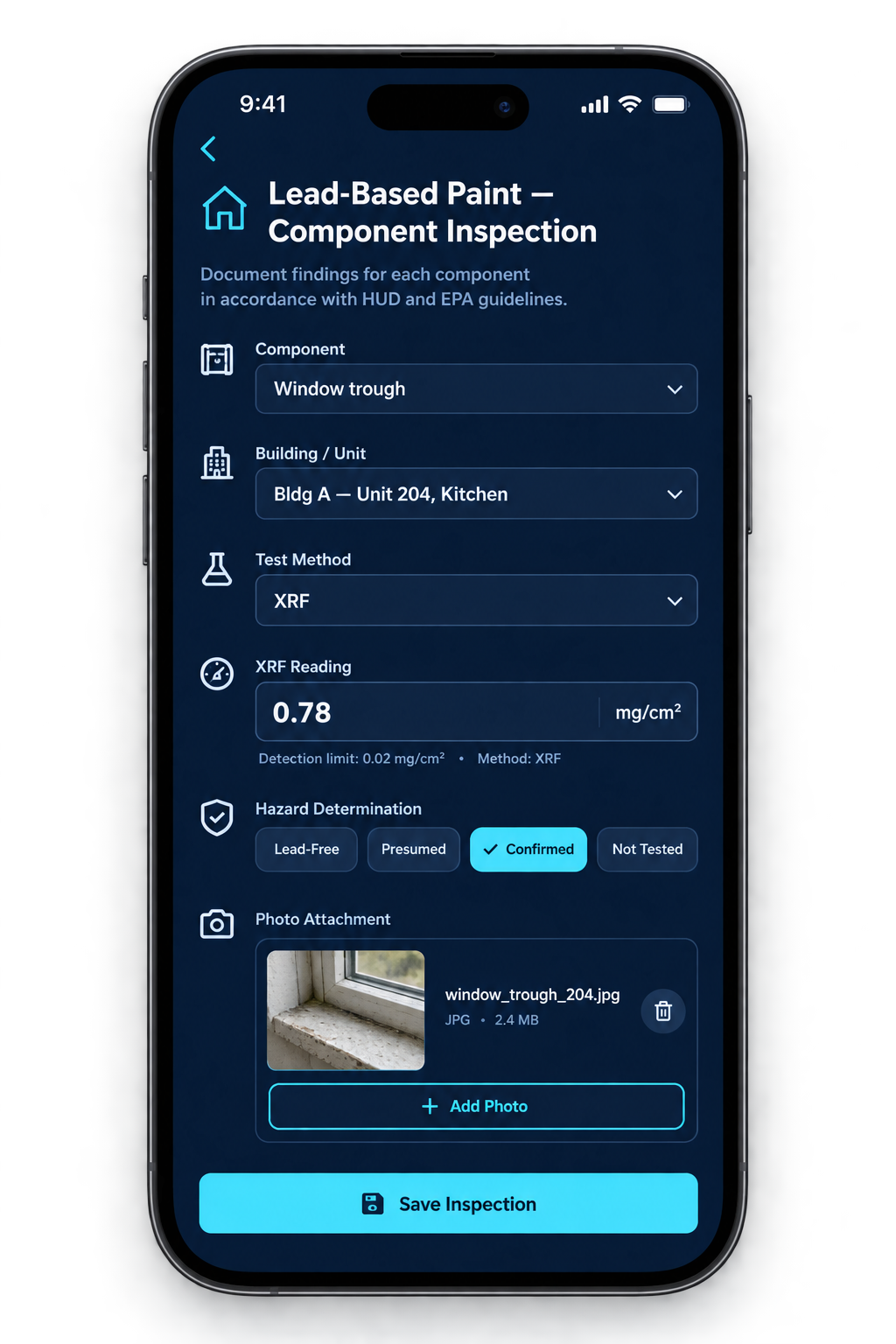 The same form on a phone: a record captured at the window, not reconstructed at the office.
Every submitted record feeds the report step of the workflow in section 12.
Ready to Explore Lead Paint Inspection Software?
If the workflows above resemble your operation, you can see how aQRate's lead paint inspection starter template works in practice — or jump straight into the live inspection demo.
17 · FAQ
Frequently Asked Questions About Lead Paint Inspection
Short answers with sources — the same sources cited throughout this article.
No. The CDC states there is no known safe blood lead level, and Health Canada states there is no known safe level of lead exposure (CDC; Health Canada).
EPA reports 31 million pre-1978 U.S. homes still contain lead-based paint, 3.8 million of them with a child under six living there. HUD's National Survey, cited via EPA's lead FAQ, puts it more broadly: about 38 million housing units — 40% of all U.S. housing — contain some lead-based paint (EPA, Oct 2024; EPA lead FAQ).
1978. EPA's lead FAQ states lead-based paint was banned for residential use that year; homes built before it are the population of concern (EPA lead FAQ).
An inspection determines the presence of lead-based paint, surface by surface — typically by XRF with lab-confirmed paint chips where needed. A risk assessment identifies hazards specifically: deteriorated paint, lead dust, and lead in soil. A third activity, clearance testing, is dust-wipe sampling after work to confirm the area is safe to reoccupy (HUD Guidelines).
Renovators disturbing more than 6 square feet of interior painted surface, or 20 square feet of exterior painted surface, in pre-1978 housing or child-occupied facilities must be lead-safe certified and follow the rule's work practices (40 CFR Part 745).
The October 2024 final rule tightened post-abatement clearance levels: floors from 10 to 5 µg/ft², window sills from 100 to 40 µg/ft², window troughs from 400 to 100 µg/ft², and set the reportable dust-lead level to any reportable level measured by an EPA-recognized laboratory. EPA projects reduced exposure for up to nearly 1.2 million people per year, including 178,000 to 326,000 children under six (EPA, Oct 2024).
Health Canada advises that homes built before 1960 probably contain lead-based paint; homes from 1960–1990 may have it on exterior surfaces and smaller amounts on interior surfaces; homes built after 1990 should be lead-free, since consumer paints in Canada and the U.S. were virtually lead-free by then (Health Canada).
Because records accumulate in layers — pre-renovation surveys, post-abatement clearance tests and periodic reassessments, judged against the standard in force at the time. A portfolio that can compare results unit-to-unit and year-to-year can answer a regulator in minutes; one with unit-by-unit spreadsheets has to reconstruct it under deadline pressure. See aQRate's multi-unit case study in Sources.
aQRate is a field-data collection and inspection-management platform: structured component-level inspection records captured on site per unit, organized and searchable by property, building and unit, with LIDAR floor-plan sketching of units and one-click Word report generation from your own template (aQRate).
It does not replace a certified inspector's or risk assessor's professional determination, does not replace accredited laboratory analysis of paint-chip or dust-wipe samples, and does not make legal clearance or compliance determinations on its own (aQRate).
18 · References
Sources & Further Reading
Every statistic and claim in this article is cited inline to one of the sources below. These are the exact references used.
01
EPA Strengthens Standards to Protect Children from Exposure to Lead Paint Dust — U.S. EPA (newsroom release, Oct 24, 2024)
31M / 3.8M homes; 2024 dust-lead clearance levels; exposure-reduction projections · https://www.epa.gov/newsreleases/epa-strengthens-standards-protect-children-exposure-lead-paint-dust02
I thought lead-based paint had been phased out. How many homes still contain lead-based paint? — U.S. EPA lead FAQ
38M housing units / 40%; 1978 residential ban (citing HUD's National Survey of Lead and Allergens in Housing) · https://epa.gov/lead/i-thought-lead-based-paint-had-been-phased-out-how-many-homes-still-contain-lead-based-paint03
Lead Fact Sheet (Oct. 27, 2021) — U.S. Department of Housing and Urban Development
3.3M families with a child under 6 in homes with lead-based-paint hazards; 2.1M low-income · https://www.hud.gov/sites/dfiles/PA/documents/Lead_Fact_Sheet_102721.pdf04
Guidelines for the Evaluation and Control of Lead-Based Paint Hazards in Housing — HUD
Definitions of inspection, risk assessment, clearance testing, XRF and lab positive criteria · https://www.huduser.gov/portal/portal/sites/default/files/pdf/Guidelines-for-the-_Evaluation-and-Control-_of-Lead-Based-Paint-Hazards-in-Housing.pdf05
Blood Lead Reference Value & Surveillance Data — U.S. CDC
3.5 µg/dL reference value (NHANES, ages 1–5, 97.5th percentile); ~3M tests/year; surveillance since 1995; no known safe BLL · https://www.cdc.gov/lead-prevention/php/data/index.html06
Lead-Based Paint in Your Home — Health Canada
Build-year risk guidance (pre-1960 / 1960–1990 / post-1990); no known safe level of lead exposure · https://www.canada.ca/en/health-canada/services/home-safety/lead-based-paint.html07
Cost of Childhood Lead Poisoning in US — Network for Public Health Law (2020)
Summarizes the Columbia Law School Health Justice Advocacy Clinic ($10.9B/annual cohort, BLL > 5 µg/dL) and Altarum 2019 (up to $83.7B, BLL > 2 µg/dL, incl. $36.7B government spending) estimates · https://www.networkforphl.org/wp-content/uploads/2020/03/Cost-of-Childhood-Lead-Poisoning-in-US.pdf08
From Spreadsheets to Insights: How Automated Data Collection & Management Saves a Multi-Unit Lead Paint Inspection From Regulatory Chaos — aQRate blog (further reading)
Multi-unit lead paint inspection scenario walked through step by step · https://aqrate.ca/blog/demo-use-case-10-from-spreadsheets-to-insights-how-automated-data-collection-management-saves-a-multi-unit-lead-paint-inspection-from-regulatory-chaosaQRate
A field data collection and inspection-management platform built by Roshan Water Solutions. This page is an educational companion to the lead paint inspection solution — the material is written for lead inspectors, risk assessors, contractors, property managers and compliance teams. Where two sources give different or seemingly inconsistent figures (the two cost estimates, U.S. vs. Canadian prevalence framing), this article states the difference rather than reconciling it.